Wednesday, April 4, 2018

Theology of the Imperial Cult pt III: Was Erebus Right?

This is another post in my series discussing the theology of the Imperium of Man. As I have said in the introduction to those posts, these are my own private musings (and certainly aren't canonical) and are not intended to refer to real-world religions (except where these are used as examples). And, of course, when you read anything here which says "The Imperium believes..." or "The Imperium teaches..." remember I am not the Imperium!

(This post contains spoilers for various novels and the background in general - you have been warned!)

In the Imperium of Man, the Emperor is worshipped as nothing less than a god, and no other form of worship (or even atheism) is permitted. But we know from the 'Horus Heresy' novels and background this was not always the case and - more significantly - during his lifetime the Emperor advanced an atheistic policy called the Imperial Truth which specifically denied his divinity (along with denying the existence of gods and supernaturalism in general).

However, when trying to persuade Horus to betray the Imperium during the vision in the Serpent Lodge on Davin (detailed in "False Gods"), the Word Bearer Chaplain Erebus claimed the Emperor has actually encouraged worship by his actions during the Great Crusade (and earlier). Erebus goes on to say the Emperor is planning to abandon the Astartes, retire to Terra and ascend to godhood (whatever that might actually mean - a separate problem I will tackle in a later post!)

This is what I am talking about when I ask if Erebus was right; the simple claim the Emperor encouraged worship and / or people to think of him as a god (for the purposes of this essay, I am defining the two as each other - we don't have a consistent definition for worship, godhood, divinity etc. in 40K, but I think we "know it when we see it"). I am not addressing the question of whether or not the Emperor is a god (that is the follow-up post "Was Lorgar right?") It is obvious Erebus was not telling Horus the full truth in the Serpent Lodge vision (but it is not obvious if that is because Erebus was deliberately lying or if Erebus himself was deceived by the powers of Chaos). I am not concerned with that - I am simply asking if, objectively, the statement the Emperor encouraged worship is an accurate one, regardless of whether or not Erebus thought he was lying when he made it.

I submit that, despite his promotion of the Imperial Truth and all the times he decries worship and supernaturalism, the Emperor did encourage others to see him as a god. I am aware this may be an unpopular opinion (the general opinion among the fandom is that the Emperor was the perfect atheist and that belief in his divinity represented a complete break with his intentions and actions). My thesis is that the Emperor presented himself in a manner which he knew (or could reasonably suppose) would lead to people thinking he was a god.

Astute readers will notice I have made an assertion some may not agree with; namely, that taking actions one would reasonably suppose would lead to a conclusion is the same as taking actions which deliberately lead to that conclusion.

I would call this the "what did you think would happen?" argument. If a man, for example, sends a dozen red roses to a woman on Valentine's Day, he should not be surprised if she thinks he has a romantic interest in her. It would be even more reasonable to presume romantic interest if he wrote poems extoling her beauty, sent her other gifts, and invited her on dates. It would be unreasonable for the man to claim he did not intend the woman to think he had romantic interest; he is acting like a man romantically interested in her.

It would be even more unreasonable for him to claim he did not intend to convey romantic interest if the woman wanted it; a man sending roses to a woman who has a crush on him must reasonably expect her to think he is interested in her.

Of course, this scenario presumes the man is aware of what his gestures mean; if he comes from a culture where the giving of red roses has nothing to do with romance and poems are written for trivial reasons etc. and he is ignorant of their meaning to the woman then it is reasonable to assume he intends no romantic affection. It doesn't matter what the woman thinks - if the man making the gesture has no idea they are common romantic gestures, he does not intend to convey romance. But, of course, if a man from a foreign culture knows what the gestures mean in the woman's culture (even though they don't mean it in his) and still choses to make those gestures, it is reasonable to think he has romantic interest.

Naturally, all of this assumes the man is not only culturally aware but that he is also intelligent. Just as an ignorant man might innocently make a gesture which conveys a meaning he did not intend, so might an unintelligent man.

But, if a man is aware of the symbolism of his actions and is intelligent enough to realize how they will be taken, one can assume he intends that conclusion to be drawn. If he publicly professes the exact opposite ("I have no interest in her, sir!") and throws up his hands in innocence and amazement people could conclude such a thing, yet acts in a manner which suggests the exact opposite and is clearly intelligent and educated enough to know it, we would not presume innocence or accident. We would presume reverse psychology.

Our example has used romance, but it can easily be applied to the Emperor. First, let's look at his actions.

First and foremost, it must be admitted the Emperor's actions, behavior, and appearance (it is strongly implied - particularly in "The Last Church" and "Master of Mankind" - the Emperor can control how he appears to others) lead people to believe he is a god and worship him. Lorgar wrote the Lectitio Divinatus and others followed the cult for a reason. Whatever he intended, people thought he was a god and should be worshipped.

The question is; did he do something which caused that, or did people just assume he was a god because he was ageless, charismatic and powerful?

He (at the very least) permitted and (probably) encouraged people to use the phrase "beloved by all" after his name. This appears from the first in the "Horus Heresy" novels, and is used not only by adherents of the Lectitio Divinatus cult, but also followers of the Imperial Truth. This sort of phrase is only found in religious contexts, especially with the official, required status it seems to have. At the start of the "Horus Heresy" novels, the Emperor has only left the Crusade recently but the phrase does not seem something new or novel. The Emperor must have been aware of its use. The fact he permitted the phrase is perhaps not indicative of him wanting to be thought of as divine, but the fact he did not suppress it certainly suggests it. He demands atheism but permits (and probably requires) an honorific for himself. Doth the gentleman protest too much?

In the short story "The Last Church" the Emperor preaches absolute atheism and offers a rational explanation for everything the priest uses as evidence of the divine, including a vision of a golden figure many decades before. This vision is the foundation of the priest's entire faith, and came after a battle against the Emperor's Thunder Warriors. At the climax of the story, the Emperor reveals himself in glory to the priest - and the priest recognizes the light and the golden figure of the Emperor as the same one he saw. It is strongly implied the Emperor was the source of the vision and, even if he were not, he chooses to reveal himself in a manner which exactly matches the priest's vision. The Emperor said it was emotion and stress which make the priest hallucinate, but now either it was him who gave the vision or he chooses to perfectly replicate it. Causing a vision or perfectly mimicking it are actions one would expect to inspire devotion.

We learn in "The First Heretic" the Emperor, after learning Lorgar was worshipping him and erecting glorious temples to him, censures the Word Bearers. He does this by destroying their holy city but also forces the entire Legion to kneel before him with his psychic power. Let that sink in; the being you consider to be a god forces you to kneel before him. Kneeling is a traditional posture of reverence to the divine - people kneel when praying or at religious services. It is a symbolic act of submission, and the Emperor forces it on the Word Bearers against their will - revealing he not only desires their submission, but will remove their free will to get it. A tyrant might demand someone bend the knee on pain of death - but a god would simply force the action.

In "Master of Mankind", the Emperor is consistently referred to using the capitalized pronoun "He". This is a traditional way of referring to God in Christian cultures (and deities in general elsewhere). Because the novel is written by and for traditionally Christian cultures (the Anglosphere) it is reasonable to assume this is intended to convey a belief in his divinity. With the exception of the "flashback" scene where the Emperor shows himself as a boy to Ra via psychic vision, this is consistent. It appears in dialog and narrative, even dialog and narrative from people who officially deny the divinity of the Emperor (so it cannot be said these people are adherents of the Imperial Cult in defiance of the Imperial Truth). Much of the novel has these characters speaking with the Emperor inside psychic visions, communication which the Emperor specifically identifies as not taking place with auditory language. The Emperor and Ra are not "speaking" to each other - Ra is being made aware of the Emperor's thoughts and the Emperor is, obviously, aware of Ra's. The distinction between 'he' and 'He" isn't obvious to our ears, but it would be to Emperor's psychic power. At no point does the Emperor say "stop thinking of me as 'He', you faith-filled loony". He lets Ra (and others, presumably) use a pronoun which has been used for the divine - something in complete defiance of his Imperial Truth.

In "Mechanicum" it is revealed the Emperor repairs a fallen Knight with but a touch - something which the Mechanicum take as a sign of his divinity. It is hard to argue this is an innocent action - if the Emperor wished to establish his technological credentials he could have done so by repairing the machine (or giving instructions on how to do so). Instead, he performs what the Mechanicum regard as a miracle. It is reasonable to assume he would have known how this action would be understood - he must have had intelligence on Mars and the cult that ruled it. It can certainly be argued the Emperor saw no other way to gain the Mechanicum's allegiance - that military defeat would be too costly or even impossible, and that using their religion gave the surest chance of success. But that actually makes the case even better; the Emperor deliberately encouraged worship to secure their loyalty. To explain why a thing is does not argue that a thing is not - in fact, it is quite the opposite.

The Emperor called his mission to unite the stars "The Great Crusade" - while clearly this (English) title is a translation of whatever it was called in High Gothic, the word chosen is one with (at the very least) religious overtones. When secular governments announce initiatives to combat social ills, they do not often use religious language (it is the "war on drugs" or the "war on poverty" not the "crusade against drugs" or "the crusade against poverty"). Even religious organizations today rarely use the word "crusade" for their initiatives; only the most strident, hard-line groups do that. The Emperor had already undertaken the Unification Wars (not Crusade) and it would have been easy to give a similar name to the galactic version of what he'd already done on Terra. The Emperor was casting his secular philosophy and government in a religious mode from the moment the armies left Terra.

In older background materials (such as the Realm of Chaos books) it is (at the very least) strongly implied the Emperor founded (or at least was the inspiration for) various cults and religions on Old Earth. The official lore seems to have backed off from that now (it has not been recently mentioned to the best of my knowledge) but it was certainly there before. A man who founds religions is not a man who has always promoted atheism - which means Erebus' claim is right.

(A tangential point which must be mentioned - the Imperial Truth is no such thing, and the Emperor knew it. He was well-aware of the nature of the Warp, he'd trafficked with the Chaos gods on Molech to obtain Warp powers. He knew the "supernatural" existed and he actively lied about it (in "Horus Rising", Horus - the Warmaster, his favored son! - appears completely ignorant of the nature of the Warp when soothing his concerned legionnaire about his experience in the Whisperheads, and Eldrad is aghast Fulgrim does not know about Chaos in "Fulgrim"). This does not, of course, speak directly to the Emperor promoting his own divinity and he may have had many reasons for obfuscating, but it reveals a track-record of lying about the supernatural.)

The vast majority of these datapoints rely on the "what did you think would happen?" argument - namely, that the Emperor might not have explicitly intended to encourage worship, but that his actions would be reasonably assumed (by an intelligent, culturally-aware individual) to lead to that conclusion. The question isn't if the Emperor was a god, or if the Emperor thought he was a god - the question is; did the Emperor take actions likely to make believe that?

And, if he did, why didn't he stop if he so wanted to promote atheism?

There are (if we allow the "what did you think would happen?" argument - an argument which, in its basic form, is allowed in current law) only three possible reasons why he did not stop.

1) He was unintelligent
2) He was culturally-unaware
3) He wanted people to think he was a god

While there is a strong cottage-industry in the fandom (and even in canon - Roboute Guilliman calls him a "terrible father") of pointing out the Emperor was deeply-flawed when it came to human interaction, he was clearly not stupid (he is described as brilliant and his various creations and projects reveal that) and he was not culturally-unaware. The Unification Wars and Great Crusade (which he led) were, in the main, military campaigns but they contained diplomatic elements (such as the unification of Old Albia) which demonstrated cultural-awareness. He is certainly guilty of sometimes failing to predict how people might react in situations which seem obvious in hindsight - the classic examples are the various traitor Primarchs who fell to Chaos / betrayed him because of mistreatment, lack of compassion etc. However, the lore is carefully written so there are no absolute good guys or bad guys - meaning that while it is possible to find a Primarch's betrayal reasonable, it is also possible to find a Primarch's betrayal unreasonable, and even ridiculous or histrionic. In short; the Emperor was not perfect but neither was he a complete dolt when it came to human interaction.

He would also have been aware of the human need to worship something larger than oneself; a lot of the lore seems to suggest the Emperor himself had a blind-spot when it came to this - that he (being so wise, powerful and perceptive) could not conceive of this human need - but the notion he was completely lacking in empathy (meaning to appreciate another might think differently) is hard to swallow. Empathy is a central component in getting people to do what you want - you have to predict how they might act, understand if not agree with their motivations, beliefs and desires. While (as mentioned above) the Emperor failed to empathize with half of his sons, he empathized with the other half just fine . . . as well as many, many millions (billions? trillions?) of humans. He knew humanity was receptive to his actions - just as the woman with a crush on a guy is receptive to any gesture of affection he might give her. A sensible person - knowing someone has a crush or a species is seeking the divine - proceeds with caution . . . unless he wants a particular conclusion to be drawn.

Taking that into consideration, I think it is reasonable to assume a man of the Emperor's intellect, cultural-awareness (even if we discard his origin story as being born in 7000BC or thereabouts, he was extant for centuries if not millennia during the Unification Wars and Great Crusade and so was not completely naïve), not to mention psychic power (which would allow him to read minds), would have known how his actions would be interpreted. He was neither unintelligent or culturally-unaware. The only possible conclusion (following Sherlock Holmes' maxim) is that - despite his promulgation of the Imperial Truth - he wanted people to think he was a god.


Seriously; I genuinely think this is the only reasonable conclusion. I can't see any argument against it unless we presume the Emperor was a complete dolt . . . something which, I think, we have to honestly say he wasn't.

Change my mind in the comments :)

=][= Danforth Laertes

The Opus: Completed Model

I actually finished this model a while ago, but I didn't get any good semi-decent pictures of it, just some quick snaps I posted on 1HourANight and my other blog to prove I'd completed it! Anyway; here are the completed pictures with various WIP shots after the jump.


Something I did deliberately, but which no-one so far has noticed - the white designs on the red panels. I patterned them after the designs seen on certain T'au battlesuits and vehicles - because the Opus was built by an emancipated gue'vesa and so reflects (as does the Corvus itself, to be honest) T'au styling.

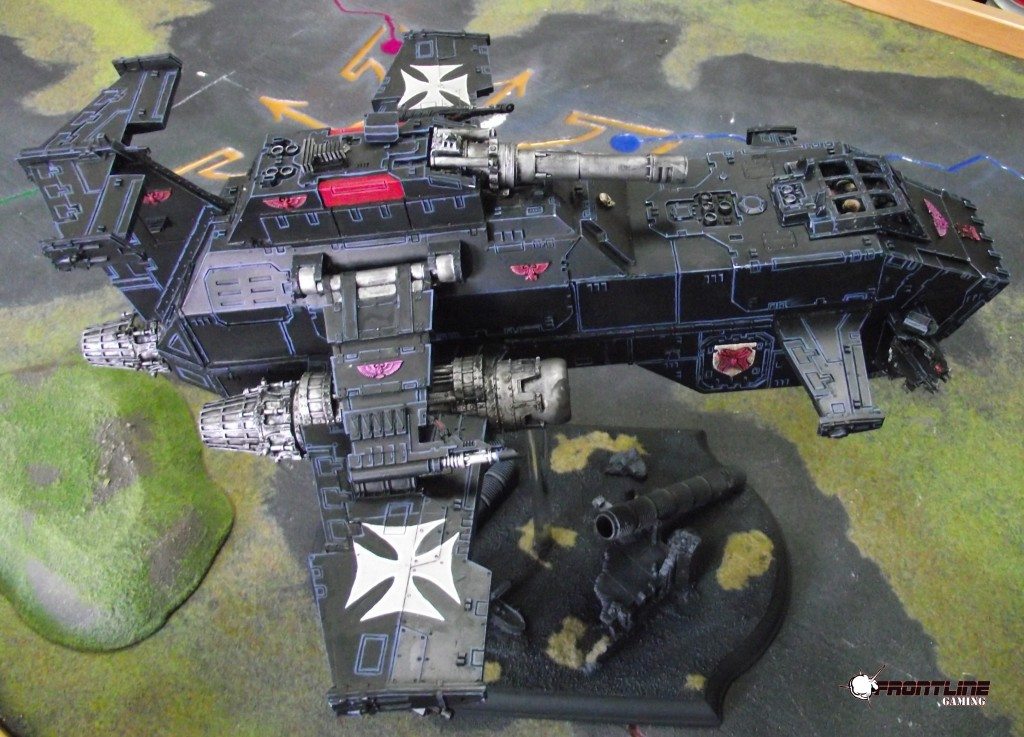
The Alexa - a Sisters of Battle Scratchbuilt Thunderhawk: main fuselage

I've been trying to avoid posting incomplete WIPs on this blog, instead posting conversions when they are completed and painted models when they are finished. But the Alexa is such a large project the assembly needs to be split up into separate posts. You can read the initial genesis of this project here.


The first thing I did was create a cardboard mockup to check the size and compare the plans to the official models, various 3d mockups and so forth. The size is good, but the main wings are too short - they are about 8.5" and they need to be nearer 10". It will be easy to design a new template for them.


The sides of the fuselage are made of the Pegasus gothic kits - I just glued them together and made a floor for them with the 3mm plasticard, with some braces on the dorsal side. The wedge-shaped cockpit and front hatchway was similarly made, all from the templates.


You can see how an (old) Immolator fits in the front section. It is not perfectly clear from this shot, but I am "cheating" the inside. The section with the rose windows will form a "command deck" for staff officers to run a campaign from, with the cockpit fo'ard and dorsal of that. This means, technically speaking, there is no way to actually exit the main body of the craft from the front door!

Not pictured is the front door I made, with working hinges and hidden magnets - I only took a video of it and blogger doesn't let me host it! I shall have to get some static shots of it.


The central engine is a cut-down podracer engine, with the rear cone cut off and a GW flier piece glued in place. It is just resting in place here.


The tail was simple but fiddly; I want to use the Pegasus roofline pieces to make the dorsal structure (where the main gun is mounted) so I had to rework the template. I made the tail from three layers of plasticard (a central 3mm layer skinned with 1.5mm) and cut a trench in the 3mm plasticard to give the impression of a control surface. Full disclosure; I miscalculated with the template (it reaches to the floor of the fuselage; I did not account for the central engine) so I will have to modify the finished piece).


Just a single picture of this, but there was a fair amount of work there. You can see the space which will become the command deck (the aft bulkhead will be a GW scenery piece with Aquila doors) and the cockpit. The idea is that the pilot and first officer / navigator can sit on the elevated chairs, with space on either side for others to look out, and a lower level for the staff officers. I had wanted to use plastic Sisters for the pilots (so it was a plastic Thunderhawk piloted by plastic Sisters of Battle, as in the meme) but I couldn't source any Immolator gunner torsos, just the legs. I will use some metal Seraphim torsos.

The cockpit needs a lot of detailing, but the main structure is there. I think the next stage will be the other main structures - the wings, dorsal structure and attaching the engines and tail.

Let me know what you think!

=][= Danforth Laertes


Wednesday, March 21, 2018

Palatine Melania: completed model


What is this? Two blog posts in one day? Two completed models? Well, don't get too excited - these have been finished for a while - I just haven't got around to posting on the blog.

This is Palatine Melania of the Order of Our Crystal Lady, one of the twelve inner-circle advisors to Canoness Shania. She is also an older conversion, based on a WarMachine figure with some Sisters of Battle additions. This use of non-standard Sisters models predates my later decision to have the uniforms and armor be standardized, but I think she works well enough. I found her in the case partially painted and rebased her on a 40mm base with some scenic elements (Palatines go on 40mm bases so they stand out on the table). She was, I think, originally intended to be a squad leader - but her cloak means she has to be a Palatine. No serious issue - this gives me another character to use! In game terms (because there is no lesser HQ than the Canoness) she can count as an Imagifer.

=][= Danforth Laertes

Saturday, March 17, 2018

The Alexa - a Sisters of Battle Scratchbuilt Thunderhawk: stage 0, planning!

First, listen to this;


If you don't think that is one of the best songs of the last half-century, you are wrong and I don't know what can be done with you.


What does Billy Joel's seminal paean to Long Island bubbies have to do with Sisters of Battle? Well, very little as it happens - but the eponymous boat of the song (inspired by Joel's own boat named after his daughter) was the inspiration for the name of my next crazy project.

(Sidebar: yes, I know I have many unfinished projects, but I am setting a "rule" - more a guideline, really - that I won't purchase a new project until I have finished the last project I bought. I have technically speaking violated this rule already with this project - I have bought the parts for it - but I am not going to start working on it until the last one I bought - the Opus - is completed.)

So what is this project? Simply put, a Thunderhawk gunship. But not any Thunderhawk gunship - a Sisters of Battle Thunderhawk gunship. With my Order's unique relationship with the Mechanicus, this is likely to not be a pure Thunderhawk, but something modified from the same chassis.

Like this, but more gothic
I did a quick internet search to see if others had done the same thing - no-one I found had done. Initially, I was going to simply buy the ForgeWorld Thunderhawk model and convert it up. But the more I thought about this, the more it seemed a foolish idea. It is 450 quid, about $630 US at current exchange rates. That's a huge amount of money for a single model - far more than I would want to spend. So, I did a more thorough search for scratchbuilt Thunderhawk templates - I thought I could use one of those.

It seems as if GW's IP lawyers have been cracking down on things, because all the links I could find led to file-hosting sites with a terse note saying accounts had been suspended for violating the terms of service. But I was able to find a very simple set of plans on Dakka which I was much inspired by. That model was made using foamboard, but I thought I could use plasticard instead. One of the features I thought very clever was the use of the Star Wars podracer for the engines.

I actually printed these plans and started to tape them together to get a better idea of scale
Later, I found this set of plans, which are the ones I am going to use (although I will be modifying them somewhat). The first thing I had to do was get 1:1 scale templates so I could see how big this thing would be and get an idea of how much plasticard I would need to buy.

Well, this was the first adventure! The proportions of each individual image are correct - that is, a line of 40mm is half the size of a line of 80mm - but each one is scaled differently to the others, so there is no way to simply print them all at a certain percentage of size and get 1:1 templates. I had to open each one in an image editing program, count the number of pixels in a particular line, do a little bit of math, and then resize the image to edit the px / in ratio so - when printed at 100% size - they would be the correct dimensions. That was a couple of hours work!

Blue lines are my conversion sketches . . . yes, arched gothic windows.
Of course arched gothic windows.
You can see the general idea of the build from the picture above - I want to use the Pegasus Gothic sets to make the sides of the fuselage (as luck would have it, they are pretty much exactly the right height when the templates are correctly scaled!) Not only will this cut down on the amount of detailing I have to do, but also provide a very authentic "grimdark cathedrals & skulls" look to the Sisters vehicle. The above image shows 4 panels along the side; I will likely go with 5.

In addition to the main plans, I was much inspired by this project from Blackadder. His scratchbuilding work is incredible, and far beyond my skills I think. But his very detailed pictures and descriptions are a great help, as is the 3d render (not his work) which he found and uploaded as the second post in that thread. I shall be using that render for detail reference as well as general scale.

I decided to build the model from plasticard, and found a good supplier in eStreetPlastics (from Billy Joel to Bruce Springsteen, eh?) I did a rough calculation and worked out that I would need 5 sheets of 12"x24" plasticard to cut out all the templates. I added one for security and bought 6 sheets each of 1/8" (approx. 3mm) and .060" (approx. 1.5mm) plasticard, and some Weld On 4 cement (I'd seen it used in YouTube crafting videos, and was intrigued by it) with an applicator. My plan is to build the body of the Thunderhawk with the 1/8" sheets and then make the distinctive "Imperial vehicle" panels with the thinner stuff.

I also bought a Pegasus Gothic set, a couple (the Thunderhawk has three engines) of Podracers from eBay (the price of these now "vintage" toys has risen since the foamboard T-hawk guide was written, but it wasn't too expensive), a handful of GW bits and a 1/8" piece of steel bar to act as a wing bracer.

My goal was to build the Thunderhawk for $225 or less (plus raiding the bitz box). This number was not quite arbitrarily chosen; it is half the Sterling cost of the official model, in US dollars. Here is the breakdown of what I've spent so far;

2x Anakin Skywalker podracer toys : $33.42
Plasticard & cement: $86.38
Pegasus Gothic scenery: $33.26
GW bits (weapons, pilots, door): $49.98
Steel bar: $7.41

Total: $210.45

The only things I am missing are two pairs of the Immolator heavy bolters (I have stand-ins - but the Immolator ones have the cool Sisters design - if you have any you are willing to part with, please comment below!)

So that is where this stands and . . . oh, what was the Billy Joel connection? Well, every vehicle in my army has a name - Magdalena the Knight-Titan, the Opus etc. - and I decided this one would be called Alexa. Alexa Resurrectrix - the reborn defender of Man. The background will be that she is a crashed Thunderhawk repaired by the Order and put to their use.

Some items have arrived (the plasticard and cement arrived today and I am super-pleased to discover initial tests indicate the cement will fuse the podracer plastic to the styrene sheets!) and others are in transit. I will begin work on her in earnest on Easter Sunday - that seems an auspicious date to start!

Let me know what you think!

=][= Danforth Laertes

Sunday, February 25, 2018

The Opus: Design, Assembly and Fiction

The completed model before priming

This post opens with an excerpt - well, a fragment written out of order - of a novel I want to write detailing the Ophidian Crusade against the Five Fingers of the Hand of Mag'ladroth, and the whole history of Danforth, Alicia, Shania and the Order of Our Crystal Lady in flashbacks. This introduces Perry and the Opus, Danforth's personal transport . . . a model which I am building and of which some pictures (and instructions on how to do the conversion yourself) appear after the story (or, if you are impatient, you can jump ahead to the conversion description by clicking here).

But I hope you will stay; I make no apologies for the length of this fiction - first, this is my blog :) But, secondly and perhaps more importantly, it is the background and story which attracts me to 40k (you can see this in the large number of history & background posts and the small number of completed models in the painting & modelling posts!) To me, my models are a reflection of the narrative I am creating.

While this WIP / tutorial is useful if you want to make exactly this model (which some people in an FB group I am in have expressed an interest in) they are also useful for the simple conversion of making the Corvus wider - another interesting conversion because the vehicle is, according to many, woefully undersized.


The starboard hangar of La Pucelle was a hive of activity, shouted commands, invectives, instructions, orders and camaraderie cutting through the promethum-haze. I ducked my head under the arch’s apex as I exited the chapel-like exterior of the Sororitas lander. I straightened and set my hat back on my head as Alicia stepped to the deck and stood beside me with a fair purr of servos. “You hungry?” she asked. “Place aft of forty-five on nineteen does a decent protein scramble and recaf.”

I shook my head. “I’m good, thanks.” I felt Alicia’s surprise - combat normally made me hungry - but the revelations in the suicidal tarot had troubled me, stirring aching memories of Anastacia more than worries, if the truth be told. I looked across the crowded deck, a line of sight opening for me like an alleyway. A deck officer - blonde and severely beautiful, braided hair lacquered beneath her peaked cap and her figure too-much for the fatigues to hide - was barking orders at a pair of scruffy pilots. They snapped and I stirred to attention.

She was not Anastacia, but she would do.

Alicia followed my gaze. She made the sign of the Aquila - warding and warning - and snorted. “You can get something delivered to her quarters,” she said with disgust. She bulled her way across the deck, the metallic stomp of her feet and the sweep of her wedge-armored shoulders cutting a respectful path.

I walked myself; toward the substitute, but my path took me past Perry and the Opus. She was kneeling by the landing gear, her slim hands busy with tools. She was still wearing her immaculate flightsuit under greasy overalls. As I approached, she turned and acknowledged me with a quick Aquila.

“How’s it going, Per?” I asked. She gave me a thumbs up. “She’s good - any damage?” She held her finger and thumb narrowly apart. “If you need help, I can . . .” She shook her head. “If you’re sure . . .” She nodded. “Alright. Well, be seeing you. The Emperor protects.”

She turned to me, actually set down the magspanner, beamed. “The Emperor protects,” she agreed.

Peregrine - Perry, Per - had come into my service during the waning days of the Indomitus Crusade. A scrawny urchin with a ragged pixie cut of adamantium-blonde hair, we had met while mutually incarcerated in the holding cell of Laertes spaceport on Ophelia VII. My presence was down to just one of the undercover parts of a complicated operation that was not nearly as exciting as you would think. She was there because Navy security had arrested her for (their words) “spying and snooping” at the Thunderbolts and Avengers hangared beyond the interdict line. She had refused - again, their words - to answer questions, only telling them “pilgrimage” when asked what she was doing and calling herself “pilgrim”.

She would have been an impish, elfin creature - diminutive and skinny, with glassbird-delicate bones and expressive eyes as wide and blue as a Cherenkov rift - but for the fact she was so laconic she could have fought in the Peloponnesian Rebellion. Then again, she might have done; she never said. That's kind of the point I am making; she said practically nothing, only speaking when simple gestures could not answer my questions. Her mind was not shuttered, but neither did it gape whorishly open - hers was a careful, route-smart, self-reliant and wary intellect ill-used by the galaxy. Despite my professional inqusitiveness, I let her keep her secrets until we escaped. I returned the favor, of course - she had no idea I was an Inquisitor until we were extra-atmospheric in a stolen (their words; I - as an Inquisitor - prefer requisitioned) Aquila lander.

She was a natural pilot - phenomenally skilled, even in the unfamiliar craft - but she nearly sent it into a tailspin when I told her. “Hand of Him-On-Earth, hand of Him-On-Earth,” she kept repeating, over and over again. “Mercy on one who has consorted with xenos. Execute me with justice but I beg you do not send me back.” A score of words, but it was the most I have ever heard her say.

She had been gue’vesa. Her ancestors - grandfathers and -mothers several greats removed - had been part of the Damocles Crusade, sacrificed to the xenos by Kryptman’s pragmatism. For generations, they had bent knees and shown throats to the perfidious T’au, betraying their species by accepting the so-called “greater good”. Their masters had let their slaves keep their religion, but had blunted it with careful control, systematically suppressing triumphalist doctrines and snuffing out even the smallest spark of the flame of humanity.

Perry had somehow slipped through their net. The xenos insisted their charges speak their degenerate pidgin and printed expurgated and bowdlerized pamphlets for use during worship, but her family had retained - perhaps without realizing what they were - a few yellowing copies of common Astra Militarium texts; the Uplifting Primer, Lives of the Saints, even a copy of the Lectitio Divinitatus. Perry had devoured them, learning Gothic from her grandparents so she could read beneath the blankets of her cot after lights-out.

The texts did their work on her better than they did on whole regiments of the Guard; she saw the teaching the gue’vesa received for what it was - heretical propaganda - and rejected the false xenos ideology of the Greater Good. Intelligent and patient enough to realize those descended through generations of indoctrination from cowards and traitors would never come to love the Imperium as she did, she bided her time and planned her escape.

She became a dutiful worker, a model slave, quick and quiet in her obedience. With the right attitude and a mind like a sponge, her aptitude overcame alien prejudice and she caught the eye of an Earth-caste aerodynamicist and became his apprentice in all but name, learning everything she could of aeronautical engineering. She jockeyed within his organization, edging out other underlings for prime positions and becoming indispensable to him. He indulged her, giving her greater access to his work, granting her more authority and autonomy.

If you think the fact she left him with a knife in his heart and his manufactorum in flames shows ingratitude or cruelty, you don’t understand the perfidy of the alien, the vileness of the xenos. Nor do you understand what Perry - a mere girl raised by aliens amid heretics and traitors - understood almost from the moment she could walk; that the manifest destiny of humanity is to rule the galaxy and that all who stand in the way of the Emperor’s vision must be crushed.

She became part of my entourage then, joining us on La Pucelle and dividing her time equally between the chapel and a large workshop just off the hangar deck that was the only luxury she ever asked of me. She must have had a name - her parents probably gave her one, and if they didn’t the T’au would have - but she shook her head when we asked. It was Wayland who realized why; that would be in the T’au language and reminded her of slavery and oppression. He took to calling her “Pilgrim” or - in the Martian-accented High Gothic the Primaris Council preferred - Peregrine. She smiled and gave a thumbs-up of thanks, introducing herself in that manner - or, rather, pointing at herself and saying “Per” when the other said his name.

She and Wayland became fast friends, communicating less with words or even gestures and more just in the shared language of design and engineering. She allowed the Salamander into her sanctum, securing the doors with maglocks of her own design, encrypted with equations outside of Imperial mathematics and which my Rosette’s omniclavis could not open. She confronted me about that once, simply saying “just ask”. I never did.

What we did ask her when we met for meals in the refectory was just what she was doing in there. “Work,” she told us, and then tucked into plain, honest, Imperial food with a gusto that belied her waif-like appearance. We joked about it - Perry’s Work. She was so taciturn - to her, Imperial Gothic was a sacred language, the tongue of not her liberators, but the utopia she had struggled her whole life to be part of, and so to waste words of it was tantamount to heresy - and so reverential when she spoke of “the work” it became an inside joke. We started to refer to it in High Gothic; Opus Peregrinas.

Eventually, she and Wayland revealed “the work” - a gift to me, to all of us, really. An air-to-ground attack aircraft and dropship, built to insert myself and my chosen strikeforce into the heart of a warzone. It was her design, a reinterpretation of STC blueprints she had requisitioned using the authority I’d given her as an Inquisitor’s personal engineer. It was a blocky but sleek piece of reverse-engineered tech-heresy, a violation of the Mechanicus’ stranglehold on technology. She had learned her discipline at an alien workbench and saw no reason to offer incense to anything except the Emperor. It was skinned in raw adamantium, a gleaming silver brick with looming wings, studded with weapons, countermeasures, sensors and VTOL thrusters, a pragmatic monster of a craft. The only concessions to Imperial whimsy were ceramite rosettes bolted to the tails and doors, and a gilded version of the same writ large on the dorsal surface.

Perry came to my elbow. She had a bottle of wine in one hand and a pot of black intumescent paint with a liner brush stuck in it. The wine was from my own cellar, and the purpose of it and the paint were clear to me - she wanted me to name the vessel; painting the appellation on and breaking the bottle against the hull. It was obvious to me. “What else?” I explained, painting the name on the prow and smashing the bottle into a thousand foaming fragments against the assault ramp.

Tinkling pieces of glass dripped from the ceramite scroll, the name Opus Peregrinas peering through the rivulets of wine.


Alright, still here? On to the pictures!

I wanted to create a special transport for my Inquisitor, Danforth Laertes. In MY house rules for Inquisition warbands I allowed a whole warband to take the Authority of the Inquisition rule which lets them board any <IMPERIUM> transport, and allowed the warband to take any <IMPERIUM> transport. So, I had a wide range to choose from. The obvious one was the Corvus Blackstar of the Deathwatch, which has the advantage of looking awesome and also being covered in many Inquisition symbols.

The problem with the Corvus, or so pretty much everyone on the internet said, was that it was too small. GW transports have always been undersized, but this one was particularly egregious they said. Also, just fielding a regular Corvus and saying it was an Ordo Hereticus Inquisitor's ride seemed like a bit of a cop out.

So, I looked around the GW range and found the Stormwolf, the Space Wolves flying assault boat. Actually, I found the Stormwolf's wedge-shaped front assault bay - I really, really like that look on vehicles and thought it would work well on the Corvus if I could make it fit.

I scoured the internet for pictures of the two models which would give me an idea of scale - there weren't many of them, and none that allowed me to see the two of them side by side but I thought I could make it work. I made a bitz order on eBay and got the Stormwolf components I would need (I didn't need the whole kit) and also bought a Corvus. I reasoned I could, once I had the pieces in my hands, hold them up to each other and carefully measure and decide if this was going to work.

The major components cut out and being placed against each other
Drawing on the blueprints to see what it might look like
I measured carefully and did math (because the blueprints at the back of the instructions are not 1:1 scale) and drew some mockups. It looked as if it might fit, but then I realized making a cardboard mockup would be easy and would give me a better idea.

Cardboard FTW!
The mockup looked good and so I resolved to actually start hacking plastic up. I first cleaned off the Space Wolf iconography from the parts I would be using and used plasticard to cover the gaps. Then I turned my attention to the Corvus itself . . .


Something that was very clear was that the main body of the Corvus would be too narrow to support the Stormwolf prow. I had been fortunate to have bought a bag full of random Space Marine flier pieces from eBay, and digging through that I found an engine assembly. With various mounting plugs trimmed off, it was 20mm wide - so I resolved to add 20mm to the width of the vehicle. I assembled the rear engines and cut them in half, inserting the new engine in the middle. I split the ventral piece of the hull in to three and added plasticard bracing so I could space it out.


I cut 10mm strips of 2mm thick plasticard and used them to rebuild the armor plates on the ventral surface. There is an angled section that required shorter strips and sanding (note; a lot of this was not visible in the final piece - I did not know exactly where the troop bay would mate with the fuselage, so I was doing more work than I really needed, but it did make the final piece stronger so was worthwhile).


I assembled the two tail sections and glued them on, attaching the sides of the ventral piece to the widened central section and glued it all together.


I cut the sides of the dorsal surface off. This was marginally more complex as the cutline needed to follow the designs embossed on the hull.


I assembled each wing and attached them to dorsal side pieces, and then attached those to the fuselage (the wings being in place made it much easier to get it all in position with the central dorsal section removed).

An underside shot of the build at this stage.
Underside shot from a different angle.

I now had to bite the bullet and cut the Stormwolf troop bay so it would fit on the fuselage. I cut it just aft and dorsal of the door jambs, leaving me with a little ledge to attach plasticard to. The above picture is with things taped in place to see how they fit.


The above picture shows where I had to glue a section I cut off from the dorsal plate of the troop bay back on; I'd shortened it too much for what I wanted. The sides of the troop bay would mate with the fuselage about a third of the way onto the spaces for the front doors with the Inquisition symbol on; I wanted to use those pieces but couldn't in that case. What I did was move the troop bay forward so I could mount them on to plasticard panels I used to extend the troop bay backwards. I also built a T-shaped bracer piece to hold the troop bay on the dorsal side (on the ventral side, it was securely glued in place).


The image above it shows the side doors glued in place (I cut the lights and controls off the side) and with the dorsal plate just resting in place.


The dorsal plate is secured to the bracers at the front, which bridge the gap between the side panels, and to the engine at the rear. The other bracers are just attached to the dorsal plate and provide support for the additional armor panels.

A three-quarter shot of the ship
Here you can see the small sockets built either side of the cockpit, which will house lascannons
A similar shot to one made before, but this time showing the dorsal plate glued in place.
You can also see some additional control surfaces glued onto the cowling of the central engine
Rear view, showing the engines and also a rear plate made from a Stormwolf component
Underside, showing how much of the earlier work bridging gaps was covered by the troop bay.
A spare piece from the Corvus was used to cover its flying stand socket; the one from the Stormwolf would be used.
Not visible is another X cut in the inner hull to allow the flying stand to fit deeply.
With that, the bulk of the work was done - the only things left were weapons and some details.


I had some assault cannons in the pile of flier bits, and assembled them. I had seen a conversion online of the Corvus where the hurricane bolters were mounted ventrally, rather than spoiling the dorsal Inquisition symbol. To make that really work, I needed to flip around the bolters and with come cutting and filing I did that.

Frontal view of the completed ship
Three-quarter view of the completed ship
A lot of little things done, but no pictures of the process! I attached the weapons, including lascannons in the sockets. I filled various gaps, added some pieces to make (stowed) landing gear at the front of the troop bay, and detailed the dorsal surface with plasticard and bits. I cut plasticard panels to detail the forward-facing spaces where the doors had previously been, and attached searchlight pieces to them.

And that, is that! A long blog post, with lots of pictures, but I hope there is something interesting or useful here. The earlier stages where I widened the Corvus show this can be done relatively easily - the only components needed are an engine from a Space Marine flier and a bunch of plasticard (I used 2mm thick as it is strong and a similar thickness to the Corvus kit). Maybe some of you will want to use that method.

I've primed the model black, and will be spraying it silver and then deciding what colors to paint it in addition to that! Watch this space!

=][= Danforth Laertes